What Your Birth Chart Actually Reveals About You
What Your Birth Chart Actually Reveals About You
For most people, astrology begins and ends with a single word: their sun sign. You read the daily horoscope for that one sign, nod or shrug, and move on. But a birth chart — also called a natal chart — is a far richer document. It is a snapshot of the entire sky at the exact moment you were born, mapped from the precise location of your birth. Rather than reducing you to one of twelve archetypes, it captures dozens of moving parts and the relationships between them. Understanding what that map can and cannot tell you is the first step toward using astrology thoughtfully.
A Map of the Sky, Not a Verdict
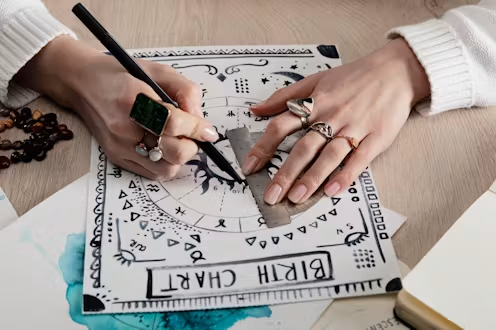
The birth chart is a circle divided into twelve segments. Around that circle sit the planets as they appeared from Earth at your moment of birth — the Sun, the Moon, Mercury, Venus, Mars, and the rest. Where each planet fell, which sign it occupied, and the angles it formed with the others all become part of your personal pattern. No two charts are identical unless two people are born at the same minute in the same place, which is why even twins can read as subtly different.
It helps to think of the chart as a description of tendencies rather than a script. It does not say “you will marry at thirty” or “you will fail this year.” What it offers instead is a vocabulary for the energies you carry — the parts of yourself that feel restless, the parts that crave security, the ways you tend to communicate when you are calm and when you are stressed. Treated this way, it becomes a mirror rather than a fortune.
The Three Layers Every Chart Contains
To make sense of a chart, it helps to know its three core ingredients: planets, signs, and houses. The planets represent what is happening — a drive, a need, a function of the psyche. The Moon, for instance, points to your emotional life and what makes you feel safe. The signs describe how that energy expresses itself; a Moon in fiery Aries reacts differently from a Moon in cautious Capricorn. The houses, finally, show where in life the energy plays out — relationships, work, home, creativity, and so on.
When you read these three layers together, the chart stops being a list of isolated symbols and starts to read like a sentence. “Your need for emotional security (Moon) expresses itself protectively (in Cancer) and shows up most strongly in your home and family life (fourth house).” That kind of synthesis is where astrology becomes genuinely useful for self-reflection.
What the Aspects Add
Beyond the placements themselves, a chart records the angles, or aspects, between planets. When two planets sit roughly 120 degrees apart, that easy trine tends to describe talents that come naturally. When they sit at a tense 90-degree square, the chart is pointing to an internal friction — two needs that pull against each other and must be consciously balanced. These aspects are often the most revealing part of a reading, because they describe not just isolated traits but the dynamics between them. The friction is not a flaw to be fixed; it is frequently the source of a person’s drive and growth.
What It Cannot Do
It is just as important to be clear about the limits. A birth chart cannot predict specific events with certainty, diagnose a medical condition, or replace the judgment of a professional in any serious matter. Anyone promising that level of precision is overselling the tool. The chart also does not override free will. Two people can share an identical placement and live entirely different lives, because temperament is only one input among many — upbringing, choices, culture, and circumstance all shape who we become.
Used honestly, astrology is closer to a reflective journal prompt than to a crystal ball. It gives you language for things you may already sense about yourself, and it can prompt useful questions: Why do I keep recreating the same conflict? Where does my restlessness actually come from? The answers still belong to you.
Why People Keep Coming Back to It
If the chart is not a prediction machine, why has it endured for thousands of years? Part of the appeal is that it offers structure for self-examination. Modern life rarely sets aside time for the question “who am I, really?” A chart provides a framework that makes that question approachable, broken into manageable pieces. It also normalizes contradiction. Most personality quizzes flatten you into a single label; a natal chart expects you to be many things at once — ambitious and insecure, sociable and private — and gives each part a place to live.
There is also something quietly humanizing about the way a chart describes you. It does not sort people into winners and losers, or healthy and broken. Every placement comes with both gifts and challenges, and the language is descriptive rather than judgmental. For someone used to being measured against external standards, encountering a portrait that simply says “here is how you are wired, and here is how that energy can work for or against you” can be unexpectedly freeing. That non-judgmental framing is a large part of why people return to the chart at different stages of life and read it differently each time.
How to Look at Yours
If this has made you curious about your own pattern, the good news is that the raw data is easy to obtain. You only need three things: your date of birth, your time of birth (as precise as you can manage), and the city where you were born. The time matters more than people expect, because it determines your rising sign and the placement of the houses; even a half-hour error can shift the layout. A free tool such as Free Psychic Birth Chart generates an accurate natal chart from your birth date, time, and place in seconds, giving you the full map to explore at your own pace.
Once you have it in front of you, resist the urge to judge any single placement as “good” or “bad.” Read the chart the way you would read a long letter from a thoughtful friend — slowly, looking for the through-lines, noticing where the description rings true and where it surprises you. What a birth chart reveals, in the end, is less a fixed destiny than a set of starting materials. What you build from them is up to you.